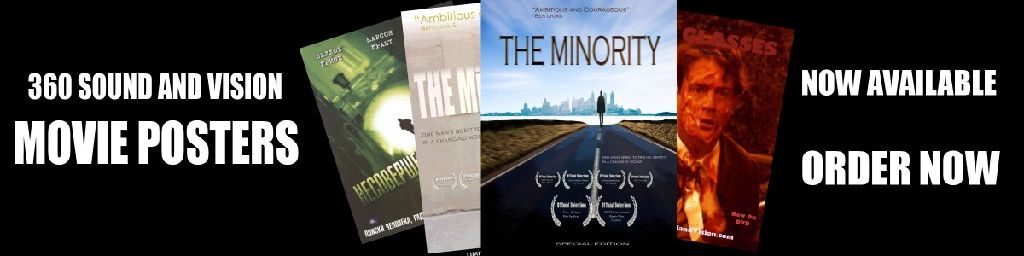
The Face In The Wall
https://www.amazon.com/Face-Wall-Jonah-Ehrenreich/dp/B07286Y6TG/
Calvin Jessup is a freelance camera man working on a low budget video production with director Bruce Leiderman
and sound man Jimmy DiCarlo, but when he sees a mysterious face in a wall of an old film location that only him
and a few of his friends can see, things start to get a little weird. Is it a ghost, a spirit or a lost soul, is there
paranormal activity within their midst? Find out in The Face In The Wall.
Starring: Frantz Lecoeur, Jonah Ehrenreich, Victoria Guthrie, Amiya Steed & Mark C. Fullhardt.
written & Directed By: Dwayne Buckle
Presented By: 360 Sound and Vision

Ex - Machina
https://www.amazon.com/Ex-Machina-Blu-ray-Digital-HD/
Caleb Smith (Domhnall Gleeson), a programmer at an internet-search giant,
wins a competition to spend a week at the private mountain estate of the company’s
brilliant and reclusive CEO, Nathan Bateman (Oscar Isaac). Upon his arrival, Caleb
learns that Nathan has chosen him to be the human component in a Turing
Test—charging him with evaluating the capabilities, and ultimately the consciousness,
of Nathan’s latest experiment in artificial intelligence. That experiment is Ava (Alicia Vikander),
a breathtaking A.I. whose emotional intelligence proves more sophisticated, s
eductive––and more deceptive––than the two men could have imagined

GET OUT
https://www.amazon.com/dp/B06Y1H48K7
Now that Chris (Daniel Kaluuya) and his girlfriend, Rose (Allison Williams), have reached
the meet-the-parents milestone of dating, she invites him for a weekend getaway upstate
with Missy and Dean. At first, Chris reads the family's overly accommodating behavior as
nervous attempts to deal with their daughter's interracial relationship, but as the weekend
progresses, a series of increasingly disturbing discoveries lead him to a truth that he never
could have imagined.

THE GLASSES 2
https://www.amazon.com/Glasses-2-Kwame-Smalls/dp/B0747BGQSJ/
The Glasses 2 is a 30 minute scifi, horror film about a special pair of sunglasses that
allows the wearer to see into the future.. a future...well... that is not so bright. But if
you had a pair of glasses that enabled you to see into the future, would you still believe
the world around you? Only time can tell in The Glasses 2.
The Glasses 2, shot in New York City, stars Kwame Smalls, Jim Bligh, and Mark Keaton
and is the sequel to the original short film. The Glasses 2 is directed by Dwayne Buckle.

Dinner with Lloyd is a feature length documentary about the legendary independent
film director Lloyd Kaufman and Troma Films. The documentary, captures the zany
Lloyd Kaufman as he talks about his life, his work, independent film, and the state
of the film industry.
Dinner with Lloyd was Shot at the Troma Films Studio in New York City.
http://www.amazon.com/Dinner-Lloyd-Kaufman/dp/B00LU8RAA4/ref=sr_1_9?ie=
UTF8&qid=1405998804&sr=8-9&keywords=dwayne+buckle

5Pointz A Historical Journey is a feature length documentary about the world
renowned graffiti museum that was once known as 5 Pointz. The documentary,
hosted by the museum's curator and graffiti artist, Meres One, takes you on a
tour of the building, giving an in depth look at the process, the artwork, the
artists, the history, and what it actually means to be a graffiti artist.
Shot in New York City, 5 Pointz:An Historical Journey's artistic and musical
style truly captures the flavor and the essence of this graffiti mecca and its
meaning.
5 Pointz:An Historical Journey will be released May 20, 2014 and will be
available internationally online and in retail outlets. 5 Pointz:An Historical
Journey will be available as a VoD (Video on-Demand), through various VoD
partners.
5 Pointz:An Historical Journey, is directed by Dwayne Buckle.
https://www.amazon.com/dp/B00IAZA6U6/ref=olp_product_details?_encoding=UTF8&me=
SPACE WOMB - THE DOCUMENTARY

Shot in New York City, Space Womb artistic style, colorfully tells Jongwang
Lee's story in a unique engaging way.
Space Womb is a feature length documentary about Korean painter
Jongwang Lee and his gallery called Space Womb. This educational
documentary reveals the inner workings of the artists life, his beginning
family life, the painter's everyday work, and the meaning behind the
Space Womb gallery.
Space Womb will be released May 20, 2014 and will be available
internationally online and in retail outlets. Space Womb will be available
as a VoD (Video on-Demand), through various VoD partners.
https://www.amazon.com/dp/B017GR5306/ref=olp_product_details?_encoding=UTF8&me=
The Official Website of 360 Sound and Vision
http://www.360SoundandVision.com

CYBORNETICS: URBAN CYBORG (special edition DVD). Features Enhanced Widescreen.
More DVD options including CYBER TOOLS Video, High Definition Theatrical Trailer
& Bonus Features. In a future world of bio-mechanical technology and awe-inspiring
scientific advances, humans share every aspects of their lives with their machines. But
when a leading scientist (James Rich) and his team build an advanced prototype cyborg
named A.R.C. 1 (Justiin A. Davis) for an undisclosed secret military project, the scientists
aren't prepared for the consequences. Suddenly, A.R.C. 1 is on his own in a strange
and dangerous world, as he embarks on a spectacular quest to discover the startling
secrets of his true identity.
https://www.amazon.com/gp/offer-listing/B00D6I7HZO?tag=360soundandvi-
&linkCode=sb1&camp=212353&creative=380553
WWW.CYBORNETICS.COM

A PRESIDENT SPEAKS - DOCUMENTARY
Committee convention on April, 11, 2014
Produced & Directed By Dwayne Buckle
https://www.amazon.com/President-Speaks-Barack-Obama/dp/B00NS340AW/

This portrait of Washington super-lobbyist Jack Abramoff, from his early years
as a gung-ho member of the GOP political machine to his final reckoning as a
disgraced, imprisoned pariah, confirms the adage that truth is indeed stranger
than fiction. A tale of international intrigue involving casinos, spies,
sweatshops and mob-style killings, this is a story of the way money corrupts
our political process. Oscar®-winning filmmaker Alex Gibney illuminates the
way politicians' desperate need to get elected and the millions of dollars it
costs may be undermining the basic principles of American democracy.
Infuriating, yet undeniably eye-opening and entertaining, CASINO JACK is
a saga of greed and corruption with a cynical villain audiences will love to hate.

a woman named Ondine (Alicja Bachleda) in his fishing net, whom he believes to be a a
mermaid. She says her name is Ondine, which means "she came from the sea". His
daughter Annie (Alison Barry) comes to believe that the woman is a selkie, a magical
seal/woman creature, while Syracuse falls helplessly in love. In the Celtic myth, a selkie
is able to become human by taking off her seal coat, and can return to seal form by
putting it back on. However, like all fairy tales, enchantment and darkness go hand in
hand. Annie hopes that Ondine has come to live on land for 7 years and that she can
use her selkie wish to cure Annie's kidney failure. Whenever Ondine is onboard
Syracuse's fishing boat, she sings a siren song, and his nets and lobster pots are
full of fish and seafood in tremendous numbers hard to believe. However, being Irish,
Syracuse (or "Circus" the nickname he is trying to outlive, one he has earned for
his previous hard drinking ways) is mistrustful of good luck, with it comes bad..

specialize in splicing DNA from different animals to create incredible new
hybrids. Now they want to use human DNA in a hybrid that could
revolutionize science and medicine. But when the pharmaceutical company
that funds their research forbids it, they secretly take their experiment
underground--risking their careers to push the boundaries of science and
serve their own curiosity and ambition. The result is Dren, an amazing,
strangely beautiful creature of uncommon intelligence and unexpected
physical developments. At first, Dren exceeds their wildest dreams. But
as she grows and learns at an accelerated rate, her existence threatens
to become their worst nightmare.

Bronx enclave of City Island. A family man who makes his living as a
corrections officer, Vince longs to become an actor. Ashamed to admit
his aspirations to his family, Vince would rather let his fiery wife Joyce
(Julianna Margulies) believe his weekly poker games are a cover for an
extramarital affair than admit he’s secretly taking acting classes in
Manhattan. When Vince is asked to reveal his biggest secret in class,
he inadvertently sets off a chaotic chain of events that turns his
mundane suburban life upside down. Winner of the Audience Award at
the 2009 Tribeca Film Festival, City Island spins a web of
misrepresentations, misinterpretations and misunderstandings into a
smart and charming comedy about a family that stops at nothing to avoid
the truth.

world doesn't know it. Oliver Stone sets out on a road trip across
five countries to explore the social and political movements as
well as the mainstream media's misperception of South America
while interviewing seven of its elected presidents. In casual
conversations with Presidents Hugo Chavez (Venezuela),
Evo Morales (Bolivia), Lula da Silva (Brazil), Cristina Kirchner
(Argentina), as well as her husband and ex-President Nestor Kirchner,
Fernando Lugo (Paraguay), Rafael Correa (Ecuador), and Raul Castro
(Cuba), Stone gains unprecedented access and sheds new light
upon the exciting transformations in the region.

redemption. In the cold winter light of the Mississippi Delta, three lonely people
stumble under the weight of a shared tragedy. Lawrence (Micheal J. Smith, Sr.)
is paralyzed with grief after the loss of his twin brother. Twelve-year-old James
(Jim Myron Ross) drifts into the perilous orbit of local teenagers while his single
mother, Marlee (Tarra Riggs), is too exhausted from her menial job to interpret
the clues. When sudden violence forces mother and son to flee their home in
the night, they alight desperately on Lawrence's property. Though this provides
safe harbor, it rekindles the fury of a bitter, longstanding conflict. Writer-director
Lance Hammer and his gifted cast of local, non-professional actors have created
an unflinching, profoundly humane story of lost souls forced by circumstance to
seek solace in the most unlikely of places.
 O
O
Moore's 'Capitalism: A Love Story' comes home to the issue he's been examining
throughout his career: the disastrous impact of corporate dominance on the everyday
lives of Americans (and by default, the rest of the world). But this time the culprit is much
bigger than General Motors, and the crime scene far wider than Flint, Michigan. From
Middle America, to the halls of power in Washington, to the global financial epicenter in
Manhattan, Michael Moore will once again take filmgoers into uncharted territory.
With both humor and outrage, Michael Moore's 'Capitalism: A Love Story' explores a
taboo question: What is the price that America pays for its love of capitalism? Years ago,
that love seemed so innocent. Today, however, the American dream is looking more like
a nightmare as families pay the price with their jobs, their homes and their savings.
Moore takes us into the homes of ordinary people whose lives have been turned upside
down; and he goes looking for explanations in Washington, DC and elsewhere. What he
finds are the all-too-familiar symptoms of a love affair gone astray: lies, abuse, betrayal...
and 14,000 jobs being lost every day.
'Capitalism: A Love Story' is both a culmination of Moore's previous works and a look into
what a more hopeful future could look like. It is Michael Moore's ultimate quest to answer
the question he?s posed throughout his illustrious filmmaking career: Who are we and
why do we behave the way that we do?
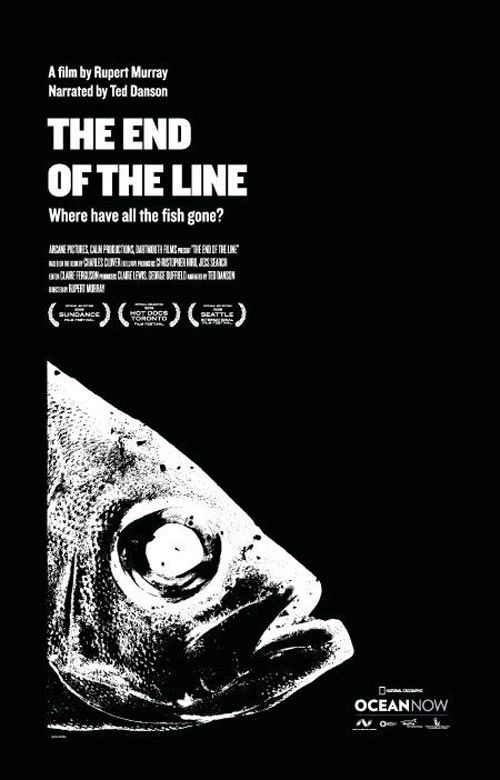
will run out of seafood by 2048 with catastrophic consequences. Based on
the book by Charles Clover, The End of the Line explores the devastating
effect that overfishing is having on fish stocks and the health of our oceans.
With Clover as his guide, Sundance veteran Rupert Murray (Unknown White Male)
crisscrosses the globe, examining what is causing the dilemma and what can
be done to solve it. Industrial fishing began in the 1950s. High-tech fisheries
now trawl the oceans with nets the size of football fields. Species cannot
survive at the rate they are being removed from the sea. Add in cofactors of
decades of bad science, corporate greed, small-minded governments, and
escalating consumer demand, and we’re left with a crisis of epic proportions.
Ninety percent of the big fish in our oceans are now gone.Murray interweaves
glorious footage from both underwater and above with shocking scientific
testimony to paint a vivid and alarming profile of the state of the sea. The
ultimate power of The End of the Line is that it moves beyond doomsday
rhetoric to proffer real solutions. Chillingly topical, The End of the Line drives
home the message: the clock is ticking, and the time to act is now.

on a wire and illegally rigged between the New York's twin towers. After nearly
an hour dancing on the wire, he was arrested, taken for psychological evaluation,
and brought to jail before he was finally released. This documentary complies
Petits footage to show the numerous extraordinary challenges he faced in
completing the artistic crime of the century.

On the 40th anniversary of the Internet, WE LIVE IN PUBLIC tells the story
of the effect the web is having on our society, as seen through the eyes
of “the greatest Internet pioneer you’ve never...
Josh Harris, often called the “Warhol of the Web,” founded Pseudo.com,
the first Internet television network during the infamous dot-com boom
of the 1990s. He also created his vision of the future: an underground
bunker in NYC where 100 people lived together on camera for 30 days
over the turn of the millennium. (The project, named QUIET, also became
the subject of Ondi Timoner’s first cut of her documentary about Harris.
Her film shared the project’s name.) With Quiet, Harris proved how, in
the not-so-distant future of life online, we will willingly trade our privacy
for the connection and recognition we all deeply desire. Through his
experiments, including another six-month stint living under 24-hour live
surveillance online which led him to mental collapse, he demonstrated
the price we will all pay for living in public. --© Official Site

these issues will be the catalyst for heated debates and positive change for
many years to come. 2008 Sundance award-winning film FUEL exposes
shocking connections between the auto industry, the oil industry and the
government, while exploring alternative energies such as solar, wind,
electricity and non-food-based biofuels.
Josh Tickell and his Veggie Van take us on the road as we discover the
pros and cons of biofuels, how America’s addiction to oil is destroying the
U.S. economy and how green energy can save us, but only if we act now.
DVD SPOTLIGHT: HOT INDEPENDENT FILMS NOW ON DVD:

underdog tale. Jamal Malik (Dev Patel) is a street kid (or "slumdog") who has landed
an appearance on India's version of the hit TV game show WHO WANTS TO BE A
MILLIONAIRE? Jamal exceeds expectations on the show, and the producers alert
the police after they become suspicious of his methods. The young contestant is
subsequently arrested and is interrogated at the hands of a nameless police inspector
(played by Bollywood star Irfan Khan). As the interrogation proceeds, Boyle tells
Jamal's story through harrowing flashbacks that both show the terrible poverty of
Mumbai and help explain how he knew the answers to the MILLIONAIRE questions.
shape. The contrast between Jamal's upbringing and his chance of escaping it on the
show are adeptly juxtaposed. Mumbai is portrayed as a place of terrifying poverty
and unforgettable brutality, and Jamal and his brother get into a never-ending
succession of challenging situations. But the way Boyle ties together Jamal's life
experiences with his answers on the show is quite brilliant, and the film really does
run the full gamut of emotions as we see him growing up, falling in love, coming
close to death, and teetering on the brink of escaping from his terrible predicament.
The film belongs to Boyle's cast, who are mostly unknown outside of India. Patel,
in particular, gives a startlingly mature performance that audiences are likely to
remember long after the credits role on this affecting feature.
Twentieth Century Fox Home Video

a Black man in America after losing his cushy office job and suddenly being
bombarded with racial biases. Jake Jackson (Billoah Greene) is one of the
nicest, most decent people you'd ever hope to meet; he works hard at his job,
leads a clean lifestyle, and just wants to lead a carefree life. But being
comfortable in your own skin isn't always easy when it's a darker shade of brown,
and after being inexplicably fired Jake begins to experience the frustration of
being a minority in a racist society. As Jake sets out in search of a new job, his
eyes are suddenly opened to the bigotry all around. Jake has worked hard to
get where is today, and all he asks in return is justice and respect. When those
things elude him, Jake begins a dark slide down the path to insanity. Only when
Jake manages to capture a wanted serial killer does his luck begin to change,
but by then he has already grown bitter after seeing the true colors of the
people he once trusted. Carson Grant, Ava Mateova, Bern Cohen and Charles Gaylord
also star in this provocative, independent drama from first-time feature director Dwayne Buckle.
360 Sound and Vision Entertainment.

on the Mohawk reservation between New York State and Quebec. Here, the
lure of fast money from smuggling presents a daily challenge to single moms
who would otherwise be earning minimum wage. Two women - one white, one
Mohawk, both single mothers faced with desperate circumstances - are drawn
into the world of border smuggling across the frozen water of the St. Lawrence
River. Ray and Lila - and a New York State Trooper as opponent in an evolving
cat-and-mouse game. Sony Picture Classics.


- BIFF: The Buffalo International Film Festival
- STEPS: International Rights Film Festival
- Michael Moore: Cinema A Love Story
- Freida Pinto: Slumdog Millionaire Hot!!!
- Lloyd Kaufman: Troma Films
- Spike Lee: Miracle at St.Anna
- Darren Aronofsky: The Wrestler
- The American Film Market
- Fred Williamson: 4 Decades of Independent Cinema
- Dwayne Buckle: A Young Director Defying The Odds
- On Set Of The Independent Film Series: The Glasses 2
- Technology: Sony EX1 XDCAM




- RECEIVE FREE EMAILS OF FILM NEWS & EVENTS.
- ACCESS TO THE INDEPENDENT REPORTERS FILM RESOURCES.